Key Findings
A decade of tracking open science reveals unprecedented transformation in research practices, with AI adoption accelerating and FAIR principles becoming mainstream.
FAIR Awareness Surge
Dramatic increase in FAIR principles awareness across all disciplines, with unfamiliarity dropping by 40-60 percentage points since 2018.
AI Tool Adoption
Active use of AI in data processing jumped from 22.1% to 31.9% in just one year, signaling rapid integration into research workflows.
Regional Divergence
Support for data mandates shows stark regional differences, with North America experiencing significant declines while Germany and India remain stable.
Credit Gap Persists
69.2% of researchers still believe they receive insufficient credit for data sharing, highlighting ongoing recognition challenges.

Fundamental research is on a very long timescale. How did we get to GPS today? We couldn't have anticipated it 60 years ago. I put open science into that same frame. This data is shared. Someone might re-analyze it tomorrow, and we get the value of that reanalysis in a week, in a month, in a year, whatever. But some of it may not be revisited for a decade.
Brian Nosek — Co-founder and Executive Director, Center for Open Science
AI Tool Adoption in Research Workflows
The integration of AI tools across research data workflows shows pronounced year-on-year acceleration, with barriers of low awareness giving way to active experimentation and regular use.
Interactive Visualization
Click the legend items above to toggle different response categories on and off. The visualization shows the dramatic shift in data processing, where active use climbed nearly 10 percentage points in a single year.

In the future, there could be tools or models that could automatically identify data discrepancies, correct them and improve them with minimal human intervention. I think that will really help with interoperability.
Dawei Zhang — Deputy Director, National Materials Corrosion and Protection Data Centre, University of Science and Technology Beijing, China
Open Science Practices Evolution
Four key metrics tracking the transformation of open science adoption from 2016 to 2025, revealing both progress and persistent challenges.

In a lot of the machine learning conferences, there are pretty strong norms around releasing code and datasets prior to review, at the same time as readers have access to the paper. That's been a nice shift as it gets at the difference between just releasing the data, and actually making it useable.
Lucy Lu Wang — NLP and Health Informatics researcher, Assistant Professor, University of Washington
FAIR Principles Awareness
Tracking global awareness of FAIR (Findable, Accessible, Interoperable, Reusable) principles reveals a fundamental shift in how researchers approach data management.
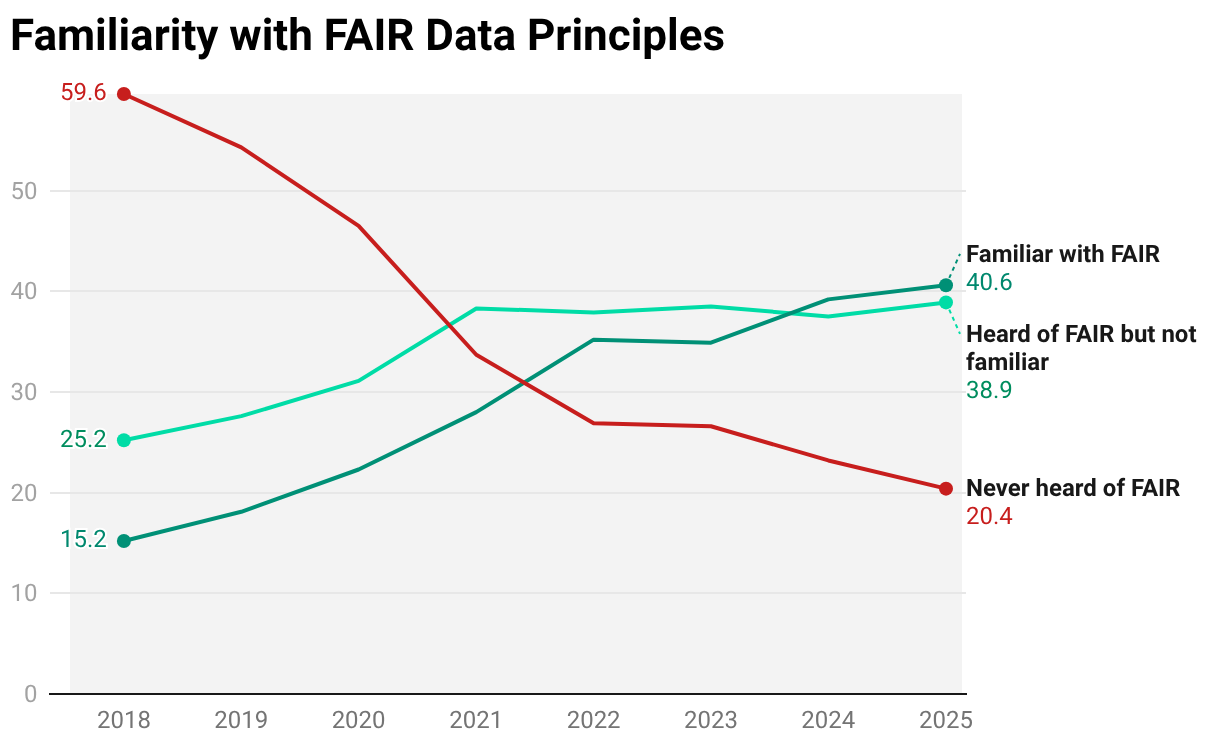
Familiarity with FAIR Data Principles, 2018–2025. Researchers were asked: "How familiar are you with the FAIR data principles (i.e. Findable, Accessible, Interoperable and Reusable)?" Use the dropdown to filter by country or discipline. Yearly sample sizes: 2018 (n = 1,239), 2025 (n = 3,932).
Explore the Data
Use the dropdown menus in the visualization above to filter by country or discipline. Click legend items to show or hide specific data series. The transformation is most dramatic in Business/Investment, where unfamiliarity fell from 80% to 20%.

I think in the next 10 years we need investment in skills. We have a real opportunity to show the true value of open data with AI. High quality, well managed data is really crucial for accurate, reproducible, and robust AI driven insights.
Hilary Hanahoe — Secretary General, Research Data Alliance (RDA)
National Data Mandate Support
Support for national data mandates reveals significant regional disparities and evolving perspectives on policy implementation across different countries.
Mandate Support by Country (2016-2025)
This slope chart reveals how support for data mandates has evolved differently across nations, with some maintaining stability while others show dramatic shifts.
Regional Patterns
Australia experienced the steepest decline (-35.8 pts), followed by Brazil (-25.7 pts) and the United States (-23.2 pts), while India (-5.1 pts) and Italy (-11 pts) demonstrated remarkable stability. These patterns suggest that initial enthusiasm may give way to more nuanced perspectives as implementation challenges become apparent.

Data management and infrastructure in research has always been expensive, so the rise of open infrastructure has been key. Let's not reinvent the wheel. The Africa PID Alliance uses existing open infrastructure that is tried and tested—we have incrementally innovated it so that it suits our community.
Joy Owango — Founding Director, Training Centre in Communication (TCC Africa), Kenya
Disciplinary Comparison
FAIR principles familiarity across academic disciplines shows how different fields have embraced open science at varying rates.
Recognition for Data Sharing
The persistent "credit gap" represents one of the most significant barriers to widespread adoption of open science practices.
The Credit Challenge
While the gap has narrowed slightly over five years, the overwhelming majority still perceive a fundamental misalignment between effort required for data sharing and professional recognition received. This suggests systemic changes to reward structures in academia have been slow to materialize.
Researchers get massive recognition and financial incentives for publishing in top tier journals. University leadership needs to do the same for open science, because this is also going to help early career researchers. It has to start from the government because I can assure you an institution will be hard pressed to start giving recognition.
Joy Owango — Founding Director, Training Centre in Communication (TCC Africa), Kenya
Recommendations for the Next Decade
1 Reform research assessment so that data sharing is given the credit it is due
To enable this, datasets need to be citable, and cited, machine-readable, discoverable, and measurable. Funders and academic institutions need to align policies that reward researchers and promote culture change through incentivising excellence in data sharing – in terms of quality as well as quantity.
2 Invest in practical, AI-enabled solutions that make sharing easier, faster, and more interoperable
Shift from policy-heavy approaches to concrete solutions: strengthen journal-repository integration, adopt common metadata and identifier standards, and use responsible AI to support metadata creation, quality checks, and format normalisation. Interoperable, human- and machine-actionable repositories, combined with clear guardrails for AI use, will raise data quality, reduce researcher burden, and accelerate reuse across disciplines.
3 Coordinate regionally and by discipline to build fit-for-purpose repositories and support systems
Develop shared infrastructures, standards, and training that reflect local contexts, disciplinary norms, and data sovereignty needs. Regional networks and domain-specific stewardship models help smaller institutions participate on equal terms, strengthen community governance, and ensure that open data practices are inclusive, sustainable, and aligned with cultural, ethical, and regulatory expectations.
A Partnership Between



Explore Further
Access the complete report, raw data, and additional resources from a decade of open science research.